Beeswax
The natural hold agent behind every great beard balm and mustache wax.
Beeswax, scientifically identified as Cera alba (white beeswax) or Cera flava (yellow beeswax), is a natural lipid secreted by worker honeybees of the genus Apis. This complex premium mixture serves as the foundational architectural material for honeycombs, where it is utilized to store honey and protect larvae. In the realm of male grooming and pharmacology, beeswax is esteemed as a premier structural agent, providing the essential viscosity and 'tack' required for topical waxes, balms, and pomades. Unlike synthetic paraffins or petroleum-based alternatives, beeswax remains biologically active, offering a sophisticated balance of protective barrier formation and breathable moisture retention.
- ›High melting point (62°C–64°C) provides superior thermal stability for styling products.
- ›Functions as a natural humectant, drawing moisture into the hair and skin.
- ›Non-comedogenic properties ensure it does not cause acne or blocked pores.
- ›Contains natural Vitamin A to support skin regeneration and health.
- ›Provides a water-resistant barrier that protects facial hair from environmental damage.
Chemical Composition and Physical Properties
The chemical architecture of beeswax is remarkably dense, consisting of over 300 individual components. The primary constituents are fatty acid esters (approximately 70%), free fatty acids (12%), and high-molecular-weight hydrocarbons (14%). It is these long-chain alcohols and acids that grant the wax its high melting point, typically ranging between 62°C and 64°C (144°F to 147°F).
For the formulator, this thermal stability is vital. It ensures that a mustache wax or beard balm remains solid at room temperature but becomes malleable upon application through friction or body heat. Furthermore, its insoluble nature in water makes it an exceptional waterproofing agent, protecting the hair shaft from environmental humidity and oxidative stress.
The Mechanics of Hold and Style
In grooming ergonomics, beeswax functions as the definitive 'hold' agent. Its molecular structure allows it to coat individual hair fibers, increasing their diameter and providing the necessary friction to lock hairs together in a desired shape. This is particularly crucial for mustache styling, where gravity and coarse hair texture demand a firm, reliable medium.
Unlike hairsprays or gels that rely on brittle polymers to freeze hair in place, beeswax offers a 'flexible memory.' Because the wax does not truly dry or evaporate, the user can restyle their beard or mustache throughout the day. The wax provides a matte to low-shine finish, avoiding the greasy aesthetic associated with lower-quality synthetic oils.
Dermatological Benefits and Skin Protection
Beyond its mechanical utility, beeswax is a potent humectant and emollient. When applied to the skin beneath the beard—an area often neglected and prone to 'beardruff' or pruritus—it creates a pro-polymeric barrier. This shield prevents Trans-Epidermal Water Loss (TEWL) without clogging pores, as beeswax is non-comedogenic when processed correctly.
Furthermore, beeswax contains trace amounts of Vitamin A (retinol), which supports cell turnover and collagen production. Its mild anti-inflammatory and antibacterial properties make it an ideal base for soothing minor abrasions caused by shaving or the coarse friction of new hair growth, ensuring the underlying skin remains as healthy as the facial hair it supports.
Sustainable Sourcing and Ethical Synthesis
The procurement of beeswax is an exercise in ecological stewardship. High-grade cosmetic beeswax is harvested as a byproduct of honey production, specifically from the 'cappings' that beekeepers remove to extract honey. This process is inherently sustainable and supports the continued health of bee populations, which are vital to global biodiversity.
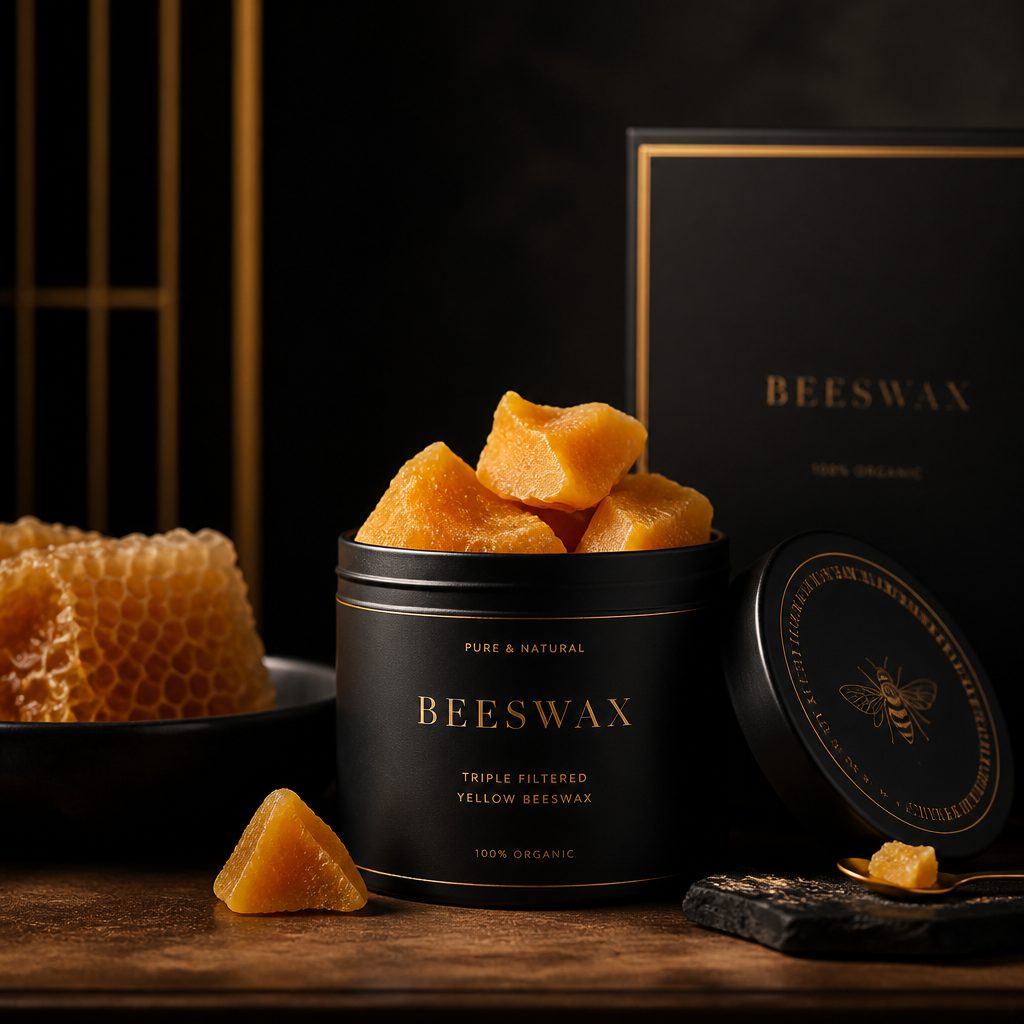
Grizzly Grooming Co. emphasizes the use of triple-filtered, pesticide-free beeswax. This purification process removes impurities and pollen allergens while retaining the wax's characteristic honey-like aroma. Industry purists prioritize yellow beeswax for its raw nutrient profile, though white beeswax—filtered using natural earth clays—is often preferred for products requiring a neutral color palette.
Formulation Synergy: Why Oil Alone Fails
A common misconception in grooming is that beard oil is sufficient for all beard types. While oils provide hydration, they offer zero architectural support. Beeswax serves as the emulsifying backbone that bridges the gap between liquid oils and solid butters. By combining the occlusive properties of beeswax with the penetrative power of jojoba or argan oil, a balm achieves a 'time-release' hydration effect.
This synergy allows for the encapsulation of volatile essential oils, slowing their evaporation and ensuring that the scent profile of a product lasts for 8 to 12 hours. Without the stabilization of beeswax, the most premium grooming products would lose their structural integrity and therapeutic efficacy before the midday mark.
History & Origin
Beeswax has been a cosmetic and grooming staple for at least 6,000 years. Ancient Egyptians used it to sculpt hair and style beards, Greek and Roman soldiers used it to seal wounds, and Victorian-era barbers built the modern mustache-wax tradition around it. It remains the gold-standard hold agent in premium beard balm and mustache wax — nothing synthetic has ever matched its warmth-activated grip.
Uses & Benefits
- ›Provides pliable, workable hold in beard balm and mustache wax
- ›Seals moisture into the hair cuticle
- ›Adds body to sparse or wispy sections
- ›Creates a light protective barrier against wind and cold
- ›Melts at body temperature for even, controlled application
Safety & Sourcing
Beeswax is safe for topical use and generally non-comedogenic when used at typical beard-product concentrations (5–20%). Choose cosmetic-grade, filtered beeswax — premium and pesticide-free is ideal. Vegans should note this is an animal-derived ingredient.
FAQ
Why is beeswax in beard balm instead of just oils?+
Because it gives the balm its structure and hold. Without beeswax, beard balm would be a liquid oil — beeswax is what lets you shape and control the beard through the day.
Does beeswax clog pores?+
At the concentrations used in properly formulated beard balm, no. Excessive amounts of low-grade beeswax can build up, so quality and formula ratio matter.
Found in Our Products
Related Comparisons
Sources
- Fratini, F. et al. (2016). Beeswax: A minireview of its antimicrobial activity and its application in medicine. Asian Pacific Journal of Tropical Medicine.
- Kurek-Górecka, A. et al. (2020). Bee products in dermatology and skin care. Molecules.