Neckline And Cheek Line: The Two Cuts That Make Or Break A Beard
- ›Neckline: curve one finger above the Adam's apple to just behind the earlobe. Never straight across.
- ›Cheek line: leave it natural unless there are obvious strays — cheating it too clean ages you ten years.
- ›Trim these lines every 7–14 days, not monthly.
- ›Use a trimmer with a guard for maintenance, a straight razor or safety razor for the crisp line.
- ›Wet trims for length, dry trims for lines. Never the other way around.
You can do everything else right and still have a beard that looks off if the neckline is wrong or the cheek line is over-cut. These two decisions do more for the finished look of a beard than every product in the medicine cabinet combined.
The neckline: the U, not the line
The single most common mistake is a neckline cut straight across the jawline. It looks tidy in the mirror and terrible in every photograph — it visually chops the beard off from the neck and creates a floating rectangle instead of a beard that belongs to the face.
The right neckline is a gentle U. Find the top of your Adam's apple, place one finger flat above it, and mark that point. From that center point, curve up on both sides to a point just behind the earlobe — following the natural arc where jaw meets neck. That curve is the neckline. Everything below it comes off; everything above it stays.
The cheek line: leave more than you think
The mistake here is the opposite of the neckline mistake: too much cutting instead of too little. A cheek line cut too clean and too low creates a strip of beard between mouth and jaw that reads more chinstrap than beard. Almost always it also ages the guy wearing it by five to ten years.
The right approach: leave the natural cheek line alone. Trim only the obviously stray hairs that grow up onto the cheekbone above where the main density stops. The soft, slightly irregular top edge of a beard reads as full and masculine; the shaved-clean cheek line reads as trying-too-hard.
The maintenance cadence
Both lines need touch-ups every 7 to 14 days. Neckline hair grows down into the U and needs to come off every week or ten days to keep the line defined. Cheek strays grow up onto the cheekbone at about the same rate. Miss a cycle and the beard starts to lose the intentional look within two weeks.
The tools for each
Trimmer with a guard for length maintenance under the neckline. Trimmer without a guard, or a safety razor or straight razor, for the crisp finishing edge. If you are new to defining necklines, use the trimmer without a guard first — a razor slip on a fresh line takes weeks to grow back into.
Wet vs dry trims
Trim for length on a dry beard (wet beard hair shrinks up when it dries and you will over-cut). Trim the crisp lines on damp skin with a razor — dry razor shaving of the neck is a razor burn factory. Order: length trim dry, wash and condition, then wet the neck skin and finish the line.
The mirror-position trick
Neckline mistakes happen because guys look down into the mirror to see under their chin, which distorts the angle. The fix: use a hand mirror to look at your neck from below, at the same angle another person would see it. What looks 'right' looking down at yourself is almost always cut too high.
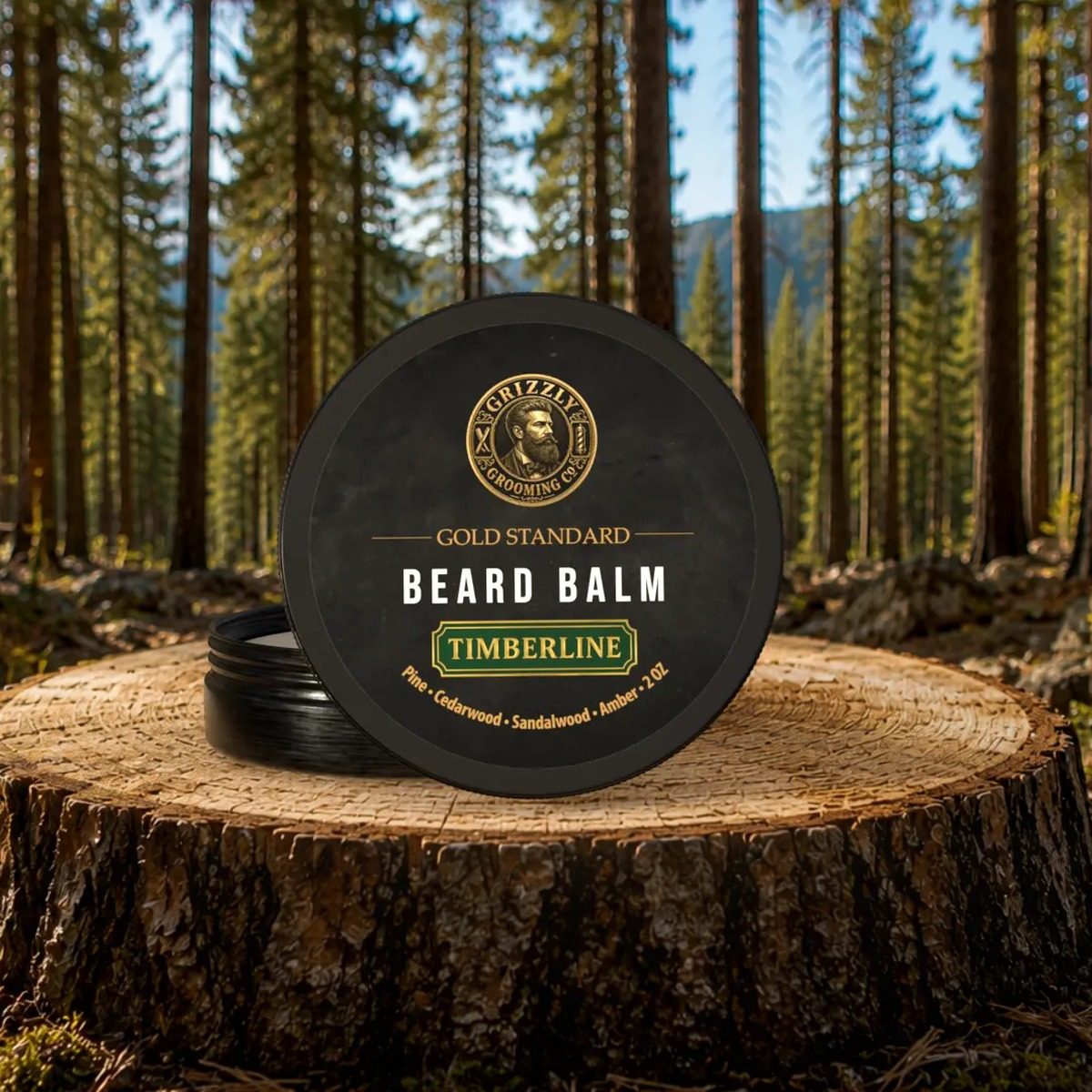
Gold Standard Beard Balm — applied after the trim, it sets the shape you just defined instead of the shape the beard was in beforehand.
Recovering from a line cut too high
There is no product fix for an over-cut neckline — only time, at roughly half an inch a month, so four to six weeks. The instinct to even it out by taking the sides up to match is what turns a small mistake into a floating beard.
Leave it alone, keep the beard conditioned so it looks healthy while it recovers, and re-establish the line only once the hair has caught up. The same applies to a cheek line cut too low: raising the other side never fixes it.
Line placement for different jaw shapes
The standard neckline — two fingers above the Adam's apple, curving up behind each ear — assumes an average jaw. With a fuller under-chin, set it slightly higher with a shallower curve; a deep U emphasizes the softness underneath it.
For cheek lines, the general rule is to follow the natural growth and remove only strays above it. Sharp, high cheek lines only look sharp when the hair beneath them is dense — on sparse cheeks they draw attention to the gaps.
Adjusting the neckline for a receding hairline or high collarbone
Men with a naturally high Adam's apple or a shorter neck sometimes find the standard one-finger rule sits visually too low once shirts and collars are factored in. In these cases, raising the curve by roughly half a finger width keeps the line from disappearing under a buttoned collar during the day.
This is a proportion adjustment, not a rule break — the U shape and the behind-the-earlobe endpoint stay the same. Only the vertical starting point shifts slightly to account for individual neck geometry, and it is worth testing in a collared shirt before committing to a permanent height.
Handling a double crown or swirl pattern on the neckline
Some men have a hair whorl on the neck where growth direction changes abruptly, similar to a scalp cowlick. Shaving straight through a whorl with a single direction pass leaves a visible patch of missed or uneven hair, since part of the whorl grows against whatever direction you chose.
The fix is a two-direction pass limited to the whorl area only: one light pass with the grain, then a second very light pass against the grain just in that localized patch, followed immediately by oil to calm the irritation. Trying to force the whole neckline into one direction to avoid this step usually looks worse, not better.
Cheek line touch-ups between full trims
A full cheek line trim every two weeks does not mean the area should be ignored in between. A handful of individual stray hairs often appear on the cheekbone within four or five days, well before the scheduled trim, and a barber's eye or a bright mirror will catch them quickly.
Pluck or snip only the two or three obvious outliers rather than reworking the whole line early. Touching the entire cheek line more often than every ten to fourteen days is what causes the over-cut, too-clean look this guide warns against, even when each individual touch-up feels minor.
Adjusting the Neckline as Your Beard Gets Longer
The correct neckline height does not stay fixed as a beard grows past a few inches — a longer beard visually pulls the eye downward, and a neckline that looked right at two inches of length can start to look too high once the beard reaches four or five. Reassess the line every few months of continued growth rather than assuming the original mark is permanent.
The adjustment is usually small, a quarter inch lower at most, and should be made gradually across a couple of trims rather than all at once. Dropping it too far in a single trim risks a visible step where the old and new lines briefly overlap before the beard grows to cover the transition.
Tools Comparison: Trimmer, Razor, and Scissors for Line Work
A trimmer with a guard is the right tool for maintaining an already-established line between full trims — fast, low-risk, and forgiving of a slightly unsteady hand. It is the wrong tool for initially defining a crisp edge, since even a zero guard leaves a slightly fuzzy line compared to a blade.
A safety razor or straight razor gives the cleanest, sharpest line and is the right choice when first establishing a neckline or for special-occasion sharpness, but it demands more skill and carries more risk of nicks and irritation with regular use. Scissors belong nowhere near either line — they are for stray hairs on the beard body, not for edge definition.
What a Botched Line Looks Like While It Grows Out
A neckline cut too high or a cheek line cut too aggressively does not fix itself quickly — hair in that region needs two to three weeks of growth just to reach a length where it blends rather than looking like an obvious gap. During that window, the honest options are patience or a slightly lower second cut to even out the visible step, not a third attempt to fix it immediately.
The instinct to keep adjusting a botched line only makes it worse, since each correction removes more hair and pushes the true fix further out. Stop touching it, let two weeks pass, and reassess with a fresh eye rather than trying to save it same-day.
Frequently Asked Questions
How do I fix a neckline I cut too high?+
Wait four to six weeks for regrowth. Do not raise the sides to match — that turns a small mistake into a floating beard.
Should I use a sharp cheek line?+
Only if the hair beneath it is dense. On sparse cheeks, follow the natural growth line and remove only the strays above it.
Where exactly should my neckline be?+
The center point sits one finger-width above your Adam's apple. From that point, the line curves upward in a gentle U to just behind each earlobe.
Should I shave my cheek line to make it sharper?+
Usually no. Trim obvious strays growing high on the cheekbone, but leave the natural top edge intact. Over-shaped cheek lines age the face and make the beard look like a costume.
How often should I trim my neckline?+
Every 7 to 10 days. Monthly is too infrequent — the line loses definition by day 14 for most men.
Should I use a razor or trimmer on my neckline?+
Trimmer without a guard is safer while you are learning. A safety razor or straight razor gives a cleaner finish but has a higher error cost. Beginner-friendly answer: trimmer.
What if I mess up my neckline?+
It grows back — usually in two to three weeks. In the meantime, resist the urge to 'fix' it by cutting more; that is how a small mistake becomes a beard reset. Wait it out and re-define at the next scheduled trim.
Should I raise my neckline if I have a short neck?+
You can shift the starting point up by about half a finger width so the line does not disappear under a collar, while keeping the same U-shaped curve and earlobe endpoint.
How do I shave a neckline with a hair whorl?+
Use a light pass with the grain across the whole neckline, then a second very light pass against the grain limited to the whorl area only, followed by oil to reduce irritation.
Can I touch up my cheek line between full trims?+
Yes, but limit it to two or three obvious stray hairs. Reworking the entire cheek line more often than every ten to fourteen days causes the over-cut look this guide warns against.
Should I move my neckline lower as my beard gets longer?+
Yes, gradually. A neckline that looks right at two inches of beard length can look too high once the beard reaches four or five inches, since a longer beard pulls the eye downward. Adjust by a quarter inch at most per trim across a couple of sessions rather than dropping it all at once.
What's the best tool for maintaining my neckline between full trims?+
A trimmer with a guard is best for maintenance — fast and forgiving of a slightly unsteady hand. Save a safety razor or straight razor for initially establishing the line or for special-occasion sharpness, since it gives a cleaner edge but carries more risk of nicks with frequent use.
I cut my neckline too high — how long until it grows out?+
Expect two to three weeks before the hair is long enough to blend rather than look like an obvious gap. Resist the urge to keep adjusting it in the meantime, since each correction removes more hair and delays the real fix. Let it grow and reassess with fresh eyes after two weeks.
"Followed the ritual in this article for 6 weeks — beard is thicker, softer, and the itch is gone. My wife keeps stealing my Timberline oil for the smell."
Join The Grizzly Brotherhood
Scent guides, grooming tips, and early access to new drops. No discount bait — just the good stuff.
Unsubscribe anytime · No spam
Get Gold Standard Beard Balm
- Everything in this article, one click.
- Built for a complete daily ritual.
- 30-day money-back guarantee.
Related Guides
Morning, evening, and weekly — in the right order.
Nine-oil breakdown, what to avoid on a label, and how to judge a formula.
Butter-forward vs wax-forward, hold levels, and the layering test.
The wash, condition, and oil sequence that changes coarse hair.
Neckline, cheekline, and the cleanup that keeps length.
What actually moves the needle across a full growth cycle.
Every oil we use, why it's in there, and how we compare.
Assemble a kit around your beard length and skin type.
Sources & Research
- International Journal of Molecular Sciences — Anti-Inflammatory and Skin Barrier Repair Effects of Topical Application of Some Plant Oils
- Indian Journal of Dermatology — Moisturizers: The Slippery Road
- American Academy of Dermatology — Face Washing 101
- American Academy of Dermatology — Dermatologists' Tips for Relieving Dry Skin
- Grizzly Grooming Co. formulation notes and batch testing records