Long Beard Maintenance: Taming a Beard Past Four Inches
Somewhere between three and five inches, a beard stops behaving like a beard and starts behaving like hair on your face — with all the same rules that hair on your head follows. Sebum can no longer reach the ends. Split ends become the limiting factor on length. Sleep positions cause visible dents. Brushing goes from optional to mandatory, and dosing that felt generous at two inches is now a fraction of what the beard actually needs. The men who cross the four-inch mark and keep a beard that looks intentional at eight or twelve inches all know the same handful of adjustments. This is that operating manual, written with our Gold Standard oil, butter, and balm as the reference products.
- ›Past four inches, the beard needs oil at the skin AND butter or balm sealing the ends.
- ›Split ends are the real length ceiling — trim the last quarter-inch every 4–6 weeks even during a grow-out.
- ›Brush morning, night, and after every application; a boar-bristle brush is the single most important tool.
- ›Sleep on silk or satin; cotton pillowcases wick oil out of the beard and cause dents.
- ›Wash cadence stays 2–3 times per week — length is not a reason to wash more.
Why Four Inches Is the Turning Point
Sebum can only travel so far down a hair shaft under its own weight and capillary action — roughly two inches for most men, three inches for some. Past that distance, the ends of the hair get nothing from the skin. The visible symptoms are a beard that looks fine at the cheeks and dull at the tips, a wiry texture in the bottom third that no amount of washing fixes, and split ends that keep the beard from gaining length no matter how much it grows.
The fix is a two-layer strategy: oil for the skin and the top half of the beard, butter or balm for the bottom half. This mirrors what long-haired people have done for centuries — a light penetrating layer at the roots and a heavier sealing layer at the ends.
The Two-Layer Application Method
Start with oil on a damp beard. Warm 8-12 drops between palms, press into the cheeks and jaw, rake outward through the beard to the tips. This is your daily minimum.
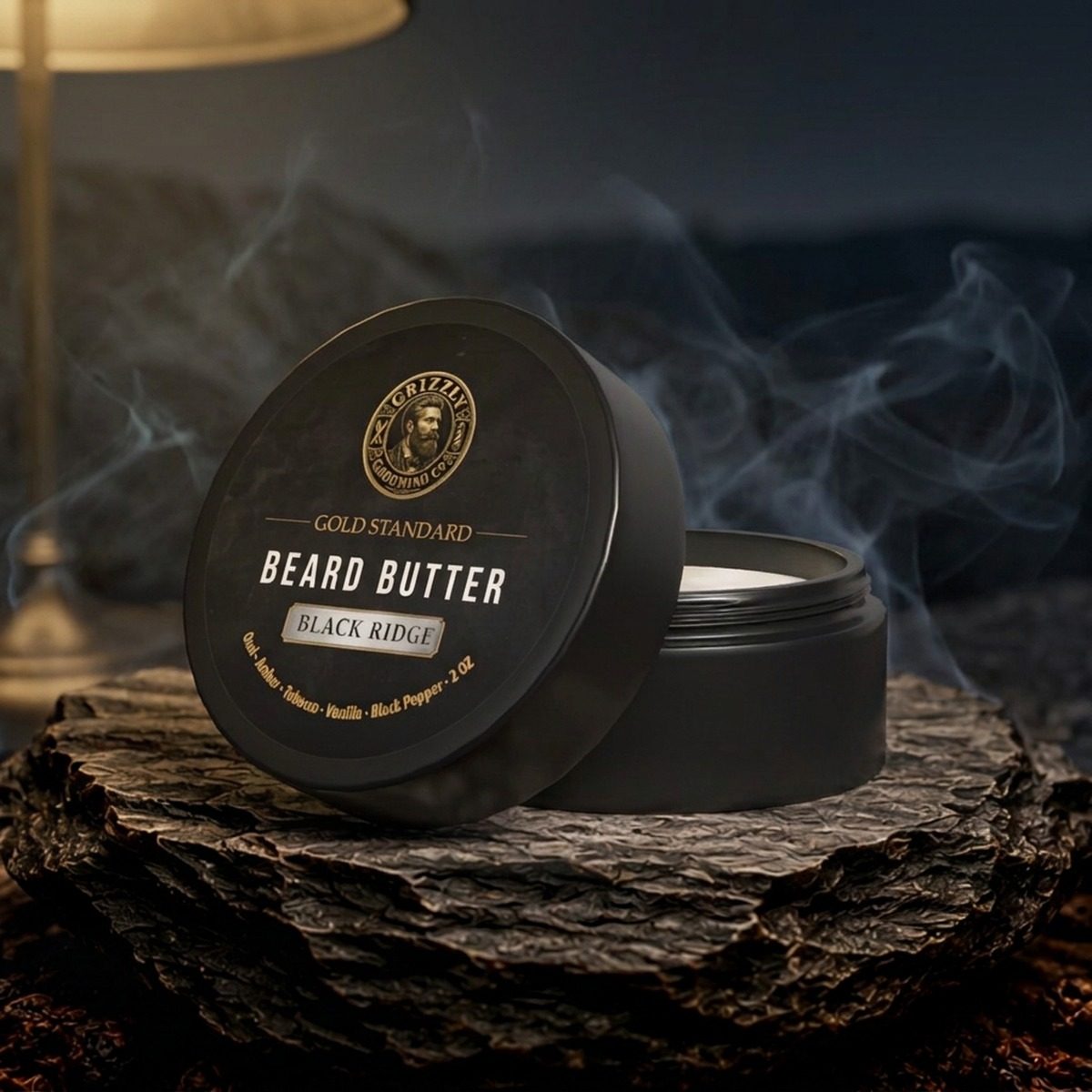
Follow with a fingernail-sized scoop of beard butter warmed between palms, applied only to the bottom half of the beard. The butter seals the cuticle at the ends where the oil evaporates fastest and gives the tips a soft, tapered finish rather than a dry fan. On heavy-styling days, swap butter for balm — same placement, more hold.
Total time: ninety seconds. This ritual, done consistently, is what separates a long beard that looks kept from one that looks abandoned.
The Split-End Ceiling
The single biggest reason long beards stop gaining length is not slowing growth — it is split ends breaking off at the same rate the beard grows. Hair grows about half an inch per month. If the last quarter-inch splits and breaks off every four weeks, the beard has hit its ceiling regardless of genetics.
The counterintuitive fix is to trim during the grow-out. Take the last quarter-inch off every four to six weeks with sharp scissors or a trip to a beard-focused barber. This does not slow growth — it removes the compromised ends before they split higher up. Most men who felt 'stuck' at six or eight inches were losing length to splits they were not addressing.
Brushing Is Not Optional
A boar-bristle brush does three things a comb cannot: it distributes oil from the skin to the tips, it lifts dead skin cells out of the beard before they flake, and it trains the hair to lie in the direction of growth. Under a comb, a long beard looks combed. Under a brush, it looks styled.
Brush morning after oiling, night before bed, and any time you re-apply product. Thirty seconds each pass, always in the direction of growth, always with light pressure. Yanking through knots snaps hair — for knots, work the tips first with fingers or a wide-tooth comb, then brush the full length once the tangles are out.
The Sleep Problem
A long beard flattens in whatever direction you sleep, and cotton pillowcases wick oil out of the beard and into the fabric overnight. Both problems have the same fix: switch to a silk or satin pillowcase. The beard slides across the surface instead of snagging, keeps the oil you applied at bedtime, and holds its natural shape until morning.
For beards past six inches, some men benefit from a loose sleep braid or a satin beard cover — this prevents the beard from being pinned under the shoulder and reduces overnight breakage. It looks ridiculous. It works.
Wash Cadence Stays the Same
A common mistake at length is washing more often because 'there is more beard.' There is more beard, but there is not more dirt — the total surface exposed to the world scales with face area, not beard length. Wash two to three times per week with a sulfate-free beard wash, rinse fully, blot dry, and re-oil immediately.
On non-wash days, cool-water rinse in the shower is enough. Over-washing a long beard is one of the fastest ways to guarantee split ends and dull tips.
The Weekly Deep Condition
Once a week, do a fifteen-minute butter mask. Apply a full fingertip of beard butter to a damp beard, work it through top to bottom, comb through, and leave in place while you shave or shower the rest of your body. Rinse with cool water, blot, and re-oil normally. This one habit does more for a beard past six inches than any product change.
Detangling a Long Beard Without Breakage
Tangles in a long beard are structural, not cosmetic — each knot is a friction point where hairs cross and abrade each other until one snaps. Never pull a comb straight through from the top. Start at the ends, work a wide-tooth comb through the last inch, then move up an inch at a time until you reach the skin.
Do this on a damp, oiled beard rather than a dry one; oil reduces the coefficient of friction between strands, which is exactly what a tangle needs. If a knot resists, separate it with your fingers rather than forcing the comb. Any comb that snags audibly is either too fine-toothed or has seam ridges from cheap molding — a sawcut wooden or horn comb solves both.
Product Volume by Beard Length
Under-dosing is the most common failure at long lengths. A three-inch beard needs roughly 4-6 drops of oil; a six-inch beard needs 8-12, applied in two stages so the skin gets its share before the length absorbs everything. Butter or balm follows at roughly a fingertip-scoop per side of the face.
The signal you are under-dosing is a beard that feels soft at the roots and straw-like at the ends by midday. The signal you are over-dosing is visible shine at the cheeks within an hour and residue transferring onto a collar. Adjust in one-drop increments over a week rather than doubling and guessing.
Weight, Direction, and Preventing the Flare
Past four inches, gravity and cowlicks fight each other and the beard flares outward at the sides instead of falling. Training solves most of it: blow dry on low heat while brushing downward with a boar-bristle brush, which sets the hair's hydrogen bonds in the direction you brushed. Five minutes, three or four days a week, is enough to change the resting shape within a month.
Butter helps hold that shape without the stiffness of wax. Apply after the dry, focusing on the sides rather than the chin. If the flare persists on one side only, it is almost always a sleeping-position cowlick — a silk pillowcase and a nighttime brush-through will do more than any product.
The Long-Beard Trim Schedule
Long beards are grown, not cut, but they still need scheduled maintenance or the outline degrades. Dust the ends every six to eight weeks — a quarter inch off the bottom, following the natural curve, purely to remove split ends. Clean the neckline every two weeks; the line sits at the top of the Adam's apple and does not move as the beard grows.
Leave the cheek line alone unless it is genuinely straying. On a long beard, a heavily edited cheek line looks artificial because the surrounding weight is soft and premium. Once or twice a year, have a barber check symmetry from the front — self-trimming in a mirror reliably takes more off the dominant-hand side over time.
Frequently Asked Questions
How much beard oil should I use on a long beard?
For a beard four inches and up, use 8-12 drops per application, usually split between morning and evening. If the beard feels tight by afternoon, add drops or add a small midday touch-up rather than one massive dose.
Do I really have to trim during a grow-out?
Yes, if you want the beard to keep gaining length. Split ends break off at roughly the same rate the beard grows, which is why most men feel 'stuck' at a certain length. Trim the last quarter-inch every 4-6 weeks to remove compromised ends before they split higher.
What's the difference between beard butter and beard balm on a long beard?
Butter is softer and mostly conditioning — it seals the ends without adding hold. Balm is stiffer and adds shape, useful for taming flyaways or styling. Most long-beard rituals use butter daily and balm only when styling for a specific occasion.
Is a silk pillowcase actually necessary?
For beards over five or six inches, yes. Cotton wicks the oil you applied at bedtime out of the beard and into the fabric, and creates friction that causes overnight dents and breakage. Silk or satin solves both problems for the cost of a single pillowcase.
How often should I wash a long beard?
Two to three times per week with a dedicated beard wash. Daily washing strips the sebum the length depends on; plain water rinses on the off days are fine and often useful.
Why does my long beard tangle overnight?
Cotton pillowcases create friction that lifts the hair cuticle and lets strands catch. A silk or satin pillowcase, plus a brush-through and a light butter before bed, largely eliminates it.
Should I use beard butter or balm on a long beard?
Butter. It is the heavier conditioning layer and is designed for length, while balm is primarily a hold product better suited to shorter, styled shapes.
When do I need to start blow drying my beard?
Around four inches, when weight and cowlicks begin to fight. A low-heat dry with a downward brush a few times a week sets the resting direction and stops the sideways flare.
Build your ritual in 60 seconds.
Answer four questions and get a custom regimen built around your beard and routine.
Start The Ritual Builder